Queen Puabi's Crown - A Journey into Ancient History
By Debbie
This is the first post in a series about exploring ancient jewelry. Margaret and I love history, but I’ve always found the oldest history to be my favorite. The first cities, the first writing, the first everything, including jewelry. It’s very hard to look back in human history and not find ways that we adorned our bodies or our belongings with the very precious metals and stones we use today. I’m absolutely fascinated by this shared connection between us and the “ancients,” and the more I look at it, the more I realize that they actually seem to be just like us in so many ways.
I want to start with one of the earliest ancient jewelry pieces I remember learning about: the headdress of Queen Puabi.

Queen Puabi may not have even been a “queen” as we know it. She may have been more of a priestess or another kind of important political or religious figure. She lived in the ancient city of Ur around 2550 BC. Ur was one of several major cities in ancient Sumer, a region in southern Mesopotamia. We do know she was important because her tomb contained elaborate personal items, household goods, and other treasures, along with the bodies of several “attendants.”
The reason we can even talk about Puabi and her fabulous headdress is that her tomb was found remarkably intact around 1922. The headdress was in pieces among her remains, but archaeologist Katharine Woolley and her team painstakingly mapped, cleaned, and reconstructed the hundreds of individual pieces to reveal what it may have looked like when Puabi wore it.
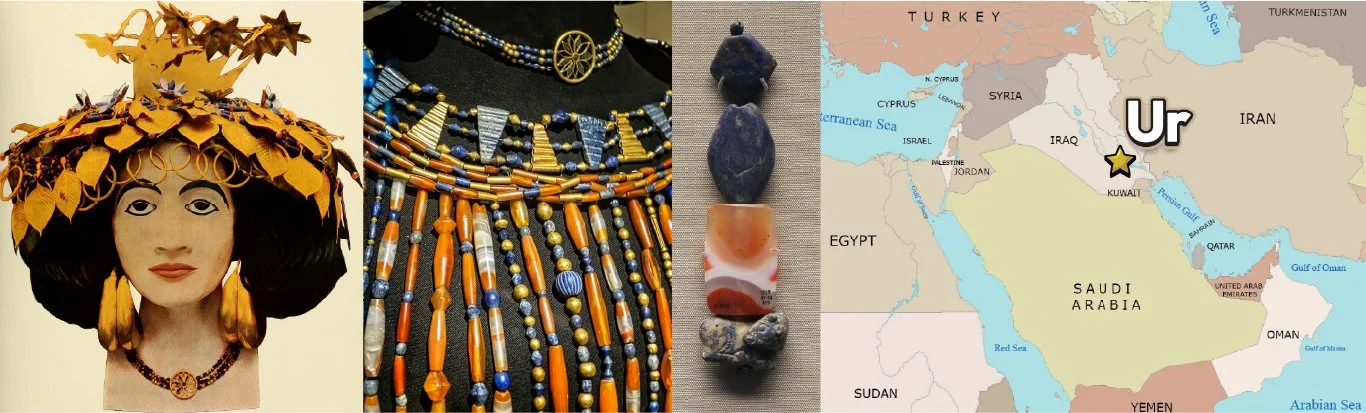
Headdress recreation, bead detail on chest piece, precious stone pendant found in tomb, map of where ancient Ur was located. License
The headdress is made up of layer upon layer of gold leaves and flowers, with long strands of gold beads hanging down around the face. At the top is a large gold comb-like piece, decorated with rosettes and delicate gold leaves, and threaded throughout are beads of lapis lazuli and carnelian, stones that still turn up in our jewelry hunting to this day. There are also gold ribbons and other pieces that would have woven through Puabi’s hair, along with an elaborate necklace or chest piece made of beads and other precious materials.
This is the beginning of so many questions.
The headdress must have been incredibly elaborate, and presumably quite heavy. But when did Puabi wear it? Why did she wear it? Was it ceremonial? Religious? Was it simply an extravagant way of dressing for someone of her status? Was it Gold Hat Friday? These things are still mostly a mystery.
The farther back in time we go, the harder it becomes to get a clear picture of what people's lives actually looked like. We have the objects, but we don’t always have the stories that went with them.
What we do know is that Puabi was not alone in her tomb. Seventy-four other individuals were found in and around the burial complex, many of them elaborately dressed and buried with jewelry and other objects like harps and pottery.
And that raises even more questions. Who were these people? Why were they there? And what does all of this tell us about Puabi herself? And that’s exactly why I love ancient history so much: Trying to imagine these ancient people with only fragments to go on.
Whatever the occasion, there’s no denying it: Puabi looked fabulous.