Vulci Set - A Journey into Ancient History
By Debbie
Next on our journey through the ancient world, let’s go to central Italy and visit the Etruscans. They lived in what is now Tuscany and parts of Lazio during the Iron Age, beginning around 900 BC. They didn’t have one big government with a capital and clear boundaries like we do today. Instead, they functioned a lot like the Greek city-states, with independent cities that shared a language, religion, and culture.
In many ways, the Etruscans were the Romans before the Romans. They wore similar clothing and created art that would later look very familiar in Roman culture, which makes sense when you remember that Rome had a habit of borrowing, adapting, and absorbing the cultures it conquered. Starting around the 1st century BC, the Etruscan cities came under Roman control, and over time the Etruscan culture was absorbed into the growing Roman world.
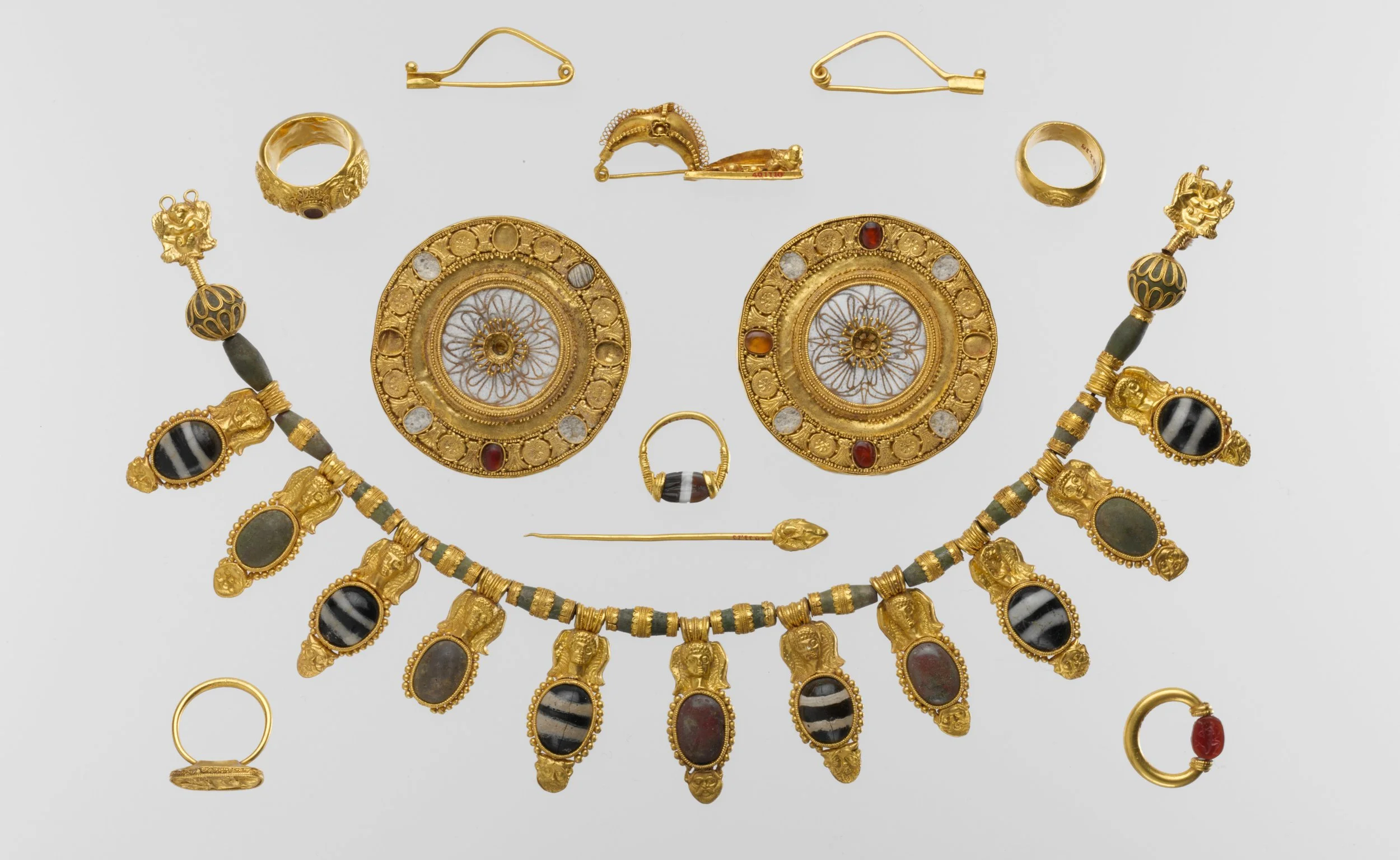
Set of Etruscan Jewelry found in a tomb in the ancient city of Vulci. Source
The jewelry I want to show you today comes from the ancient Etruscan city of Vulci, from around 500 BC. Around this same time, the Greeks and Persians were fighting their wars, and Sun Tzu was writing The Art of War in China. It’s one of my favorite things about ancient history: while we tend to separate these civilizations into completely different stories, they were all happening at the same time.
These pieces were found in a two-chamber tomb in 1832, but the people who wore them remain unknown. They were probably very wealthy, given the extraordinary craftsmanship that went into these pieces.
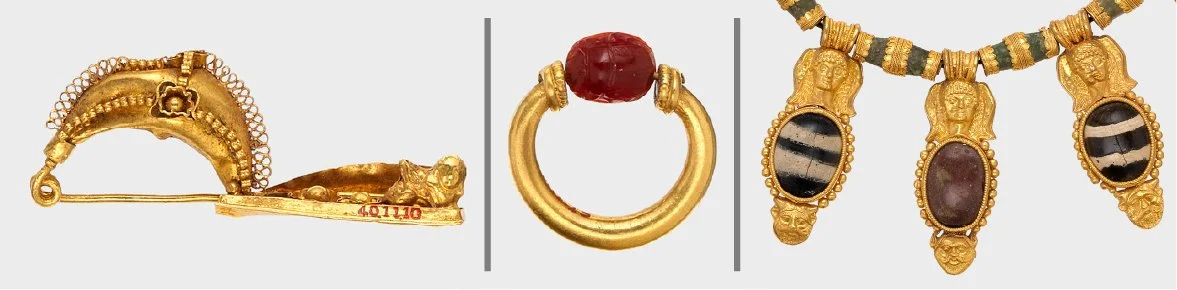
Sphynx dress pin, Scarab carnelian ring, siren and satyr pendant details. Source
The set itself is almost overwhelming in the best possible way. There is a gold and glass pendant necklace made up of multiple strands of beads, with a large central pendant that would have sat prominently on the chest. There are enormous round gold earrings, gold rings, and several fibulae, which were essentially the ancient world's very fancy version of a safety pin used to fasten clothing. The gold work is incredibly detailed, especially the tiny granules of gold that decorate the surfaces. These little beads were individually made and attached to the jewelry to create patterns and texture, which is the kind of painstaking work that makes me tired just thinking about it. And then there are the creatures: sphinxes, sirens, satyrs, scarabs, and other figures worked into the designs. Some of these motifs came from the Greek world, some from Egypt and the Near East, and some were adapted by the Etruscans themselves. It is a wonderful jumble of gold, color, mythology, and craftsmanship, all packed into one tomb. Looking at the collection as a whole, it is easy to imagine how spectacular it must have been when it was actually being worn, rather than carefully arranged behind glass thousands of years later.
And this is what I find so fascinating about ancient jewelry. It’s easy to imagine these early cultures as isolated from one another, each living in its own little ancient world. But they weren’t. These objects tell us that people were trading, traveling, and exchanging ideas across enormous distances. The Etruscans were making jewelry in Italy featuring creatures and designs that came from cultures much farther away.
Even 2,500 years ago, apparently, jewelry was one of the ways the world got a little smaller.